
Tallinn Excavator Plant, Paide branch
Таллинский экскаваторный завод
After the re-occupation of Estonia in 1944 it was decided to build the Central Mechanical Repair Workshop of the Roads Administration of the People's Commissariat of Internal Affairs of the Estonian SSR on the site of a former match factory in Paide. Construction was completed at the beginning of 1946, and at first the workshop repaired engines and road machinery that had survived the war.
The same year, 1946, Arnold Volberg (2.07.1900 – 7.08.1967), one of Estonia's most outstanding mechanical engineers, began designing a road grader based on GAZ-AA truck units (engine, front and rear axles), which was named V-1 after the initial of the designer's surname. The first grader was completed in 1947 and took part in the May Day demonstration in Tallinn in 1948. Although the V-1 was a rather primitive design even by the standards of the time, it was the first self-propelled grader built in the Soviet Union! As far as is known, a total of 122 V-1 graders were built. After the V-1, Volberg went on designing new types of grader. In quick succession the V-2, V-3, V-4, V-5, V-6 and V-8 were completed. Whereas all the earlier types had the petrol engine of the GAZ-AA truck, the V-8 (weighing 8 t), the first heavier grader built in Estonia, had a 55 hp NATI-3 engine. As far as is known, only 6 V-8 graders were built.
In the 1950s the Central Repair Workshop was renamed the Paide Road Machinery Plant.
In November 1953 the prototype of the first three-axle grader, the V-6-3 (the designation E-6-3 was also used in parallel), was completed. This type had the petrol engine of the GAZ-51 truck. From 1953 to 1956, 505 V-6-3 graders were built.
In 1954 Volberg began designing the V-10 grader. Its power unit was the D-54 diesel already familiar from the DT-54 crawler tractor (all graders built at the plant until then had petrol engines), and it was the only grader in the Soviet Union at the time to use hydraulic control of the working equipment instead of the usual mechanical control. From 1956 to 1962, 2040 V-10 graders were built, making it Volberg's most successful grader.
In 1962 the Paide Road Machinery Plant was merged with the Tallinn Excavator Plant, which made chain excavators for land improvement and in 1975 was renamed the production association "Talleks".
At the end of the 1950s a state standard for motor graders was developed. The V-10 grader then in production did not meet its requirements. In 1958 the newly founded design bureau of the Paide Road Machinery Plant, under engineer Villem Gross, began designing an improved grader, which under the all-Union standard was designated D-512. The first trial batch of D-512 graders was completed at the end of 1962. It was powered by the SMD-14A engine of the T-74 crawler tractor, and the D-512 was the first grader built in Paide with power steering. Unfortunately grader production in Paide ended as early as 1966, when Moscow decided that the Tallinn Excavator Plant must increase production of chain excavators, the association's main product. As production capacity was urgently needed for this, it was decided to end grader production at the Paide plant. The D-512 thus became the last grader built in Paide. In total 1675 D-512 graders were built from 1962 to 1966.
Over 19 years a total of 4348 graders were built in Paide, most of them V-10s and D-512s. Despite the end of production, graders built in Paide, especially the V-10 and D-512, remained widespread road machines in Estonia for many years and were also used extensively in other Soviet republics. Road administrations generally wrote off their V-10 and D-512 graders by the late 1970s and early 1980s at the latest. Many graders from the Paide plant, however, instead of being scrapped after being written off, went to collective farms, state farms and other organisations for which buying new graders was difficult. Many V-10s and D-512s were therefore still in use in the 1980s and even the early 1990s.
Besides graders, the Paide plant also built 46 bitumen sprayers, mounted both on Soviet trucks and on the chassis of the Ford 6 truck imported as US military aid during the Second World War, and 210 snow ploughs. From the end of grader production in 1966 until the end of the 1980s, the Paide branch of the Tallinn Excavator Plant (from 1975 the production association "Talleks") made components, mainly working units for the chain excavators built by the association. Today AS Paide Masinatehas, the successor of the former grader plant, makes various welded structures of carbon and stainless steel for machine building and general construction. Its range includes various sprockets and gears, axles, shafts, containers of up to 40 m³, various scraper and belt conveyors, mechanical log splitters and snow clearing machines.
Further reading: Mairut Marmor. The new life of road machines (magazine "Tehnikamaailm" no. 10, 2008) See also the AS Paide Masinatehas website!
Exhibits by this manufacturer (1)
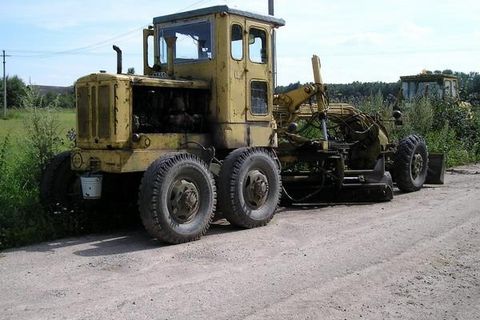 | #188 | D 512 | 1965 | Road grader |