
Kharkiv Self-Propelled Chassis Plant
Харьковский завод тракторных самоходных шасси
Text: based on literature, Raul Aarma, Taavi Võsa. Edited by Silver Kuik
Since 1956 the Kharkiv self-propelled chassis plant has built four-wheeled frame tractors, still in production today, which with mounted and towed implements were used for vegetable growing and inter-row cultivation in orchards, and also for transport on livestock farms and construction teams and, with special equipment, for construction work (various lifts) and road maintenance (road marking machines).
The plant was founded in 1949. In 1950, in parallel with the Kharkiv Tractor Plant, it began building the KhTZ-7 tractor, which continued until 1956. In 1956 the plant was reorganised to build self-propelled chassis, which have remained its main product to this day. The first models, the DSSh-14 and DSSh-14M, had the D-14 single-cylinder liquid-cooled diesel from the DT-14 tractor with 14 hp, while the next model, the DVSSh-16, had a somewhat more powerful 2-cylinder 4-stroke air-cooled D-16 diesel with 16 hp. The DVSSh-16 remained on the assembly line until 1961, when production of the T-16 began in its place.
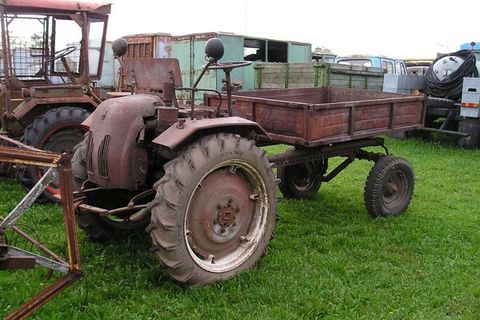
The T-16 is a development of the DVSSh-16, differing from its predecessor mainly in its reversible gearbox. Tractors of this generation had no cab yet, but a sunshade could be fitted on request. A few tractors of this generation have survived to this day and are still working in private hands. They can be distinguished from later generations (T-16M, T-16MG) by their curved engine cover instead of a square one.
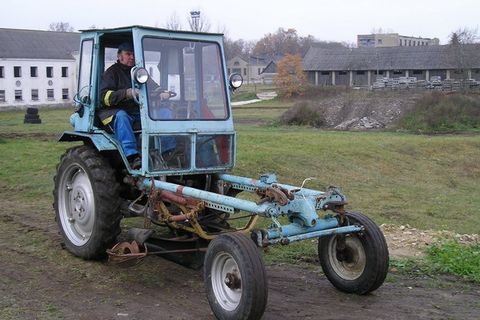
In 1967 production of the T-16M began, with a more powerful air-cooled 2-cylinder D-21 diesel engine, also used on the T-25. Besides the base model, the T-16MMCh for working in tea plantations and the low-clearance T-16MT, intended mainly for greenhouses, were built. The T-16M differs from its predecessor in having an alternator and, as a result, a simpler cooling fan, and later versions also in having a jointed steering column. Only a few tractors with the generator in the fan have survived. Whereas the first series left the factory with an upright one-piece steering column, later examples had split columns with a universal joint. This somewhat improved the ergonomics of the controls. The steering mechanism itself and the box gears did not change. For work in the hotter regions of the Soviet Union the tractor already had an opening roof and a fan in the cab as factory equipment. To the left of the seat, on the rear wall of the cab, there was also a special holder for the 3-litre drinking water flask supplied with the tractor. For winter work, however, the factory's practically only official option was a special disc placed in front of the fan blades to limit the flow of cold air onto the cylinders.
The T-16MG variant (G in the name stood for "gidravlicheskii", i.e. hydraulic) differs from the T-16M in its fully hydraulic steering (not to be confused with power assistance!). An external sign of hydraulic steering is the absence of a drop arm and track rod in front of the front axle. The steering cylinder with its rod is behind the axle. In addition the steering column tilts along its full length, and the dashboard is at the lower edge of the windscreen rather than 20 cm above it. There are also two hydraulic pumps (one for steering and one for the working hydraulics).
A rotor-valve-type oil pump was attached to the lower part of the redesigned steering column, which, as the wheel was turned, directed hydraulic oil through hoses to the cylinder turning the front axle. The steering used hydraulic oil from the same reservoir as the implement linkage, but pressure came from a separate pump section. In the last years of the Soviet Union the plant finally also delivered examples with a rear linkage. The engineers of the great homeland never offered a PTO for driving rear-mounted implements. Unfortunately. As is well known, its East German sister, the RS 09, also widely used in Estonia from the mid-1960s, always had both a rear linkage and a PTO.
As the engine, cab and running gear stayed the same, the T-16MG is distinguished from the T-16M by the following: one radius rod in front of the front axle instead of two, the steering arm on the right front stub axle extending to both sides (on mechanically steered examples it extends only forward), 4 outlets on the hydraulic oil tank instead of 2, a long double-section oil pump instead of a single-section one, and the hydraulic mechanism attached to the steering column protruding below the cab. In addition, the left tube of the front half-frame running parallel to the direction of travel is closed at both ends (on the earlier model the steering link rod ran there).
Production of the T-16M and its variants continued until 1995.
In the mid-1990s production began of the SSh-28 self-propelled chassis and its variants, and the AT-1 small tractor, 85% shared with the T-16M, was also developed.
Today the plant's main product is the SSh-2540 self-propelled chassis, which like its predecessors is built in various versions. The plant's main customers are both agricultural and industrial enterprises. Currently the chassis are fitted with the D-120 air-cooled diesel engine built at the Vladimir Tractor Plant, but because of limited deliveries of these engines, preparations are being made to use engines of similar power built at the Kharkiv tractor engine plant and the Malyshev plant.