Engineering plant "Uralets"
Механический завод "Уралец"
The plant's history can be traced back to the first half of the 19th century, when large deposits of gold and platinum were discovered 40 km from Nizhny Tagil (now in the Sverdlovsk region). A forced labour camp called Aurora was opened there in 1837. In the 1920s the camp was renamed Krasny Ural (and later still Kirovsky). Later the camp was also part of the GULAG system, with its own fully developed infrastructure. This included various engineering workshops, which after the camp closed in 1953 remained the settlement's only employers (name: Kirovsk engineering workshops; Russian abbreviation KMM).
In 1954 KMM was placed under the "Zolototrans" trust of the USSR Ministry of Non-Ferrous Metallurgy. Its products became spare parts for GAZ, MAZ and ZiS vehicles and buses based on the GAZ-51 that resembled the PAZ-651. These buses had no specific designation.
At the end of the 1950s the industry's administrator changed once again, this time to the Economic Council (Sovnarkhoz) of the Sverdlovsk region. The company was named the "Uralets" vehicle unit plant. In 1962 a large military order was received for ZiL-157 van bodies (Russian abbreviation KUNG) and special bodies on the MAZ-200 (the body of Old Tech Park exhibit no. 128, a MAZ-200, was made there). ADS-50 and AKDS-70 oxygen production stations were fitted in these MAZs.
In 1965 the plant's administrator changed yet again, this time to the USSR Ministry of Defence. The search also began for customers interested in the plant's products, one of them being the USSR Ministry of Culture. At the end of that year the plant, meanwhile renamed the "Uralets" engineering plant, was placed under the "Roskultprombyt" trust of the Ministry of Culture of the Russian SFSR.
In 1966 the forward-control Uralets-66 bus, based on the GAZ-51A truck, was developed, and it went into production in 1967. As the Ministry of Culture also owned the Kuban plant in Krasnodar, it turned out that the lion's share of Uralets output went to Siberia, the Urals and the Far North, while Kuban buses went mainly to the European part of the country. In the best years up to 1200 buses left the plant.
In the first half of the 1970s the Uralets-66 was modernised and redesignated Uralets-66AS. In the early 1970s about 500 Uralets-70 buses with a modernised design were also built. Production of the Uralets-66 lasted until 1979, when the bus failed tests organised by the USSR Ministry of the Automotive Industry – the buses lacked a dual-circuit braking system and the test results were poor. After bus production ended, the plant began making (unspecified) fairground attractions; today the plant is a subsidiary of the Nizhny Tagil metallurgical combine and mainly makes furniture. The exact number of Uralets buses built is not known.
See more here too!
Exhibits by this manufacturer (1)
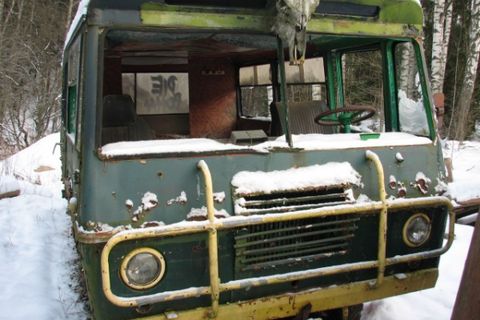 | #189 | Uralets-66 | 1969 | Bus |