Kaunas Car Repair Plant
Kauno Autoremonto Gamykla
In 1920 the company "Amlitas" was founded in Kaunas, then the capital of Lithuania. The name meant "American Lithuanians' joint-stock company", and the company's business was car repair and coachbuilding. The first Ford-based buses were built there in 1924.
In independent Lithuania there were two larger bus builders in Kaunas: "Amlitas" and the garage of the Kaunas municipal bus company in the Šančiai suburb of Kaunas. The plants built buses for the whole of Lithuania, on Ford as well as, for example, MB, MAN and Saurer chassis. In 1940 the plants were nationalised; the Soviet occupation and the Second World War temporarily ended bus production in Kaunas.
After the end of the Second World War two car repair enterprises were first set up in Kaunas: Car Repair Plant No. 3 on the basis of "Amlitas", and the Kaunas bus body repair workshop on the basis of the bus company's garage. A year or so later the two bus builders were merged into the Kaunas Car Repair Plant (Russian KARZ, Lithuanian KAG). At first the plant repaired trophy vehicles and built bus substitutes on trucks (mainly the ZiS-5 and Studebaker US-6). In 1949 KAG specialised in the major overhaul of GAZ-MM and ZiS-5 trucks and buses based on them, and at the same time began producing the L-1 bus with a wood-and-metal body, based on ZiS-150 units. This model was built until 1952, when by decision of the Council of Ministers of the Lithuanian SSR KAG specialised in the major overhaul of GAZ trucks.
The same year a new workshop was built in the former body repair workshop, where production began of the KAG-1, a bus with a wooden frame resembling the GZA-651. The plant was then headed by V. Pupeika, with V. Paulavičius as chief designer. The KAG-3, whose development was led by the same engineers Pupeika and Paulavičius, went into production in 1956. The bus had a carriage-type body on a wooden frame, was based on the GAZ-51A and carried 23+7 passengers. At least in Lithuania the KAG-3 was the most common bus in rural districts, long after series production of the PAZ-652 began. At the end of the 1950s about 350 new buses were built every year. The plant also overhauled KAGs, building a new body for each bus every 4–5 years.
In 1962 bus production moved from Šančiai to the suburb of Aleksotas, where a plant under the Lithuanian Ministry of Agriculture had repaired GAZ-51s. Before that, in 1959, the KAG-4 bus with an all-metal body, also based on the GAZ-51A, was designed under Pupeika. The KAG-4, however, remained a prototype, as at the same time the USSR Ministry of the Automotive Industry redistributed the priorities of various car repair plants. The KAG-41 all-metal van was also designed on the KAG-4, but in the Baltic states the production of special vans went to the Tartu Experimental Car Repair Plant. As a result the outdated KAG-3 stayed in production, though its appearance was modernised over time using elements planned for the KAG-4.
Four series of the KAG-3 can be distinguished in total; the first two can be recognised by their three-piece windscreen. Small numbers of mobile workshops and other special vehicles were also built on the KAG-3. Until the end of production the KAG-3 body was based on a wooden frame.
As the share of PAZ and LAZ buses grew, production of the KAG-3 ended (the exact year is not known).
In 1979 KAG began overhauling Ikarus buses, two years later KamAZ engines for the whole Baltic region, and from 1987 other units too. Alongside buses, hearses based on the UAZ-452 were also built.
The plant ceased operating in its previous form in January 1993, and its assets were privatised the same year. The plant's legal successor UAB Autosabina is engaged in metalwork and transport and is the Lithuanian representative of Honda and Citroën.
According to official data, KAG built about 12,000 buses and special vehicles over its lifetime.
Link to a short summary of the plant's history
Exhibits by this manufacturer (1)
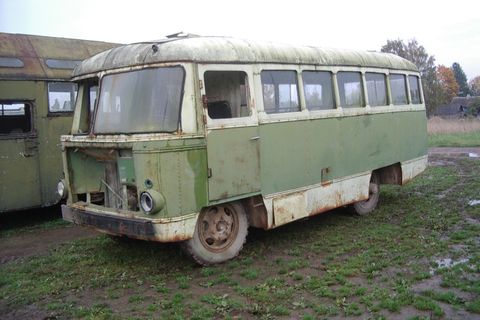 | #137 | KAG-3 | — | Bus |