
Volkswagen Nutzfahrzeuge AG
The history of Volkswagen as a car brand begins in the 1930s, when the German Führer Adolf Hitler gave the well-known engineer Ferdinand Porsche the task of designing a car for the whole German people that could carry four persons. At the time the official name of the car was KdF-Wagen, after the state organisation KdF (Kraft durch Freude, Strength through Joy). The car plant was built on a completely empty site, which grew into today's town of Wolfsburg. The Second World War temporarily halted all plans to produce the KdF-Wagen; after Germany's surrender the badly damaged plant ended up in the British occupation zone. The new administrators decided to restore car production, based on Porsche's design. The legendary German engineer Heinrich Nordhoff (1898–1968) was put in charge of the plant. The company was named Volkswagen in 1946. At first only the 1200 model (nicknamed the "Beetle") went into production at Wolfsburg. In 1947 Ben Pon, the Dutch VW importer, came up with the idea of building a light truck on the "Beetle". The first prototypes were completed in 1949, and just a year later the first generation of the VW Transporter (T1) went into production at Wolfsburg. It was rear-engined and based on the main units of the "Beetle". In 1956 a dedicated van plant was completed in Hanover, and Transporter production moved there. The T1 was built until 1967 as a van, minibus and single- and double-cab pickup. Its successor, the T2, was quite similar in shape, keeping the rear engine, air cooling and earlier body types. In 1975 Volkswagen's van range was expanded with the LT series with a larger payload; in 1979 the T2 was replaced by the square-shaped T3 series. In the early 1980s diesel engines were added to the T3 range, and air cooling was replaced. The Austrian company Steyr-Daimler-Puch also began assembling four-wheel-drive versions of the T3, and the range was extended with the more luxuriously equipped Multivan and Caravelle bus versions. The bottom of the range was extended in 1982 with the Caddy, a pickup based on VW Golf units and assembled in Sarajevo. In 1977 a cooperation agreement was also signed with the truck maker MAN, which began using VW LT cabs on its lighter trucks (7.5–12 tonnes gross weight); these models were also marketed under the VW-MAN name (vehicles in this series were assembled both at the VW plant in Hanover and at MAN in Salzgitter). In 1981 a plant was also opened in the Brazilian town of Resende. In 1989 the Taro pickup, a renamed Toyota Hilux assembled at the Hanover plant, went into production as the fourth van model. In 1990 there was a revolution in Volkswagen van building: the T4, with front engine and front-wheel drive, debuted as the T3's successor. Its body types were bus, van, pickups and chassis. Two years later production of the Caddy stopped because of the war in Bosnia. In 1995 van and truck production was separated from car production; the company was named Volkswagen Nutzfahrzeuge AG (VWN) and its headquarters moved from Wolfsburg to Hanover. In 1996 the LT series, built for almost 20 years, was replaced by a new model generation designed together with Mercedes. Around the same time the Caddy returned to production, this time as a renamed version of the Seat Inca. Production of larger trucks also began in Brazil, and the 7.5-tonne L80 also reached the European market. In 2003 both the T4 (replaced by the T5) and the Caddy were replaced (the new Caddy is based on VW Golf and Touran units and assembled in Poznań, Poland). In 2006 the LT was also replaced; the new van is called the Crafter and is built at Mercedes' Düsseldorf and Ludwigsfelde van plants. VWN's current range in Europe includes the Caddy, Caddy Life, Transporter, Caravelle, Multivan, California and Crafter; in the South American market also heavy trucks, the flagship being the Constellation Titan tractor unit with a gross weight of 42 tonnes. VWN is one of eight carmakers in the Volkswagen Group, together with the Volkswagen parent company, Audi, Seat, Škoda, Bentley, Lamborghini and Bugatti. Its plants are in Hanover (T5-based models), Poznań (Caddy, T5) and Resende in Brazil (heavy trucks). In 2006 a record 441,700 vehicles were built.
Website
Exhibits by this manufacturer (3)
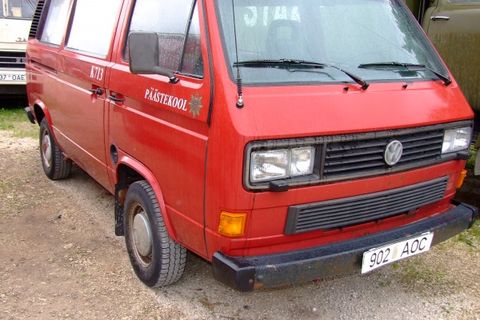 | #208 | Volkswagen Transporter Kombi (T3) | 1990 | Minibus |
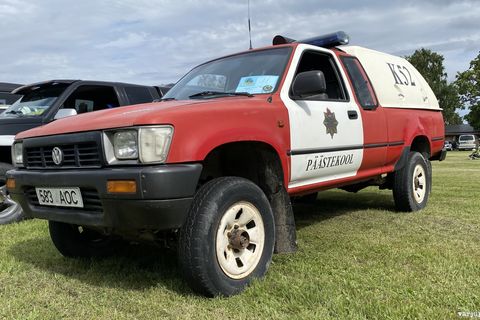 | #330 | Volkswagen Taro | 1991 | Van |
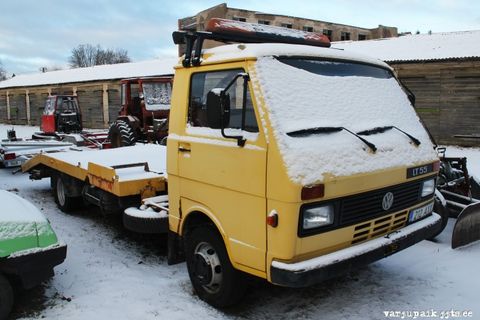 | #431 | Volkswagen LT 55 | 1990 | Special-purpose vehicle |